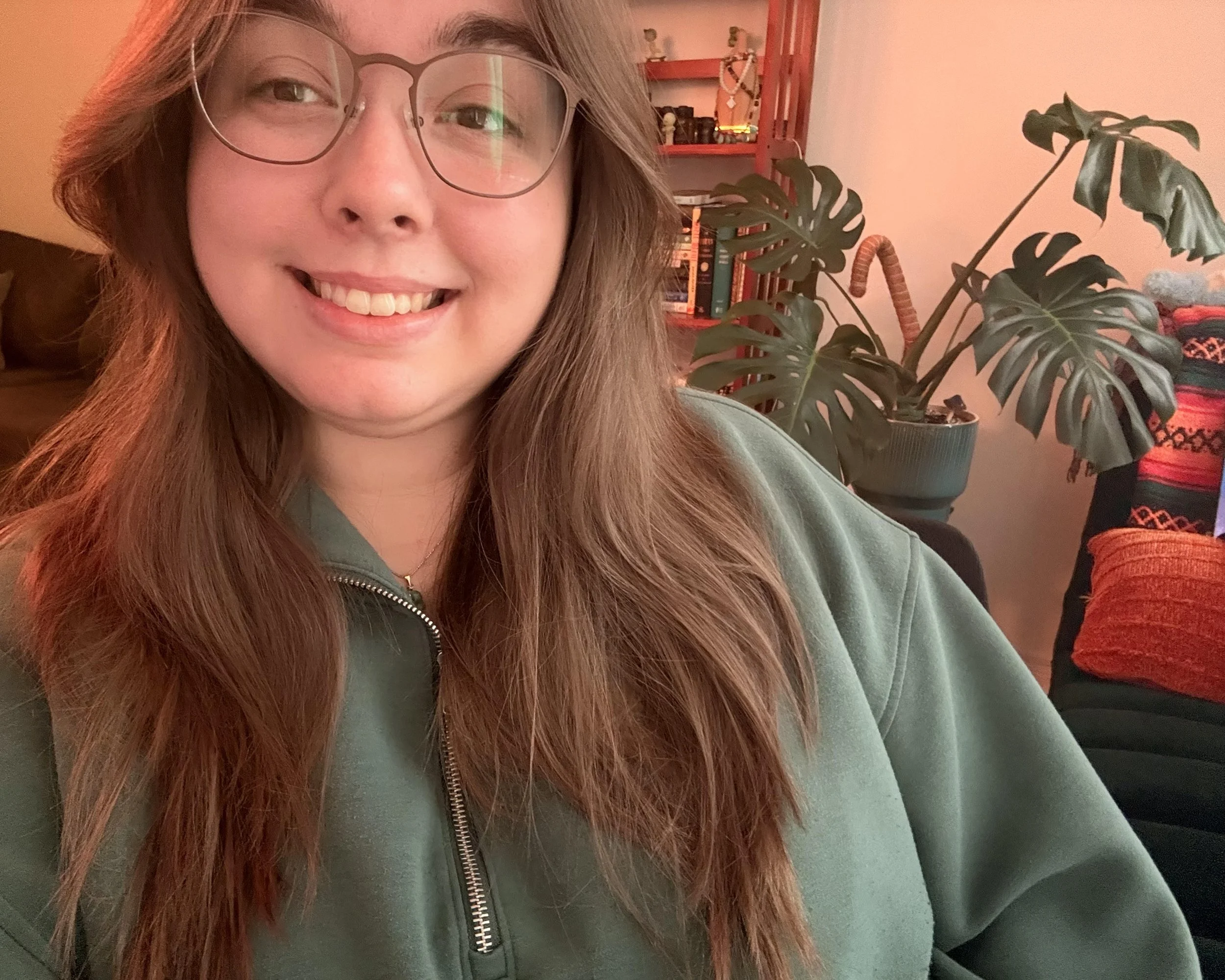
Taylor Loesekam
Before becoming a therapist, I was simply a person trying to make sense of myself and the world around me — and, in many ways, I still am.
Like many of the people I work with, I know what it feels like to feel disconnected from yourself, to question your place in this world, or to find your nervous system responding to life in ways that feels like it doesn’t make sense. My own experiences have taught me that healing rarely comes from just making our ‘symptoms’ go away. More often, it emerges when we have the space to witness what becomes possible when we are given the space to connect with who we are beyond survival, expectation, and hypervigilance.
My path into therapy was shaped by a deep curiosity about people and a belief that much of our suffering makes sense in context. Through my work, education, and lived experiences, I’ve come to understand how our relationships, communities, systems, and stories shape the way we understand ourselves. This curiosity continues to guide my work as a therapist and the questions I carry outside of the therapy room.
As you move throughout this page, you’ll find a little more about my training, the values and perspectives that guide my work, and few glimpses into who I am beyond the therapy room.
MACP, Registered Psychotherapist | Pronouns: She/Her
-
Master of Arts in Counselling Psychology, Yorkville University
Bachelor of Arts in Psychology, Arizona State University
-
Registered Psychotherapist #17189, College of Registered Psychotherapists of Ontario
Qualifying Member #72608329, Ontario Society of Registered Psychotherapists
-
Accelerated Experiential Dynamic Psychotherapy (AEDP) Level 1 Certification
Complex Trauma Certification Training Level 1 & 2, Janina Fisher & Evergreen Certifications
Emotionally Focused Individual Therapy Level 1, Sue Johnson & Leanne Campbell
Somatic Therapy for Complex Trauma Certification: Body-Based, Polyvagal, & Neurobiological Techniques for Mind-Body Healing, Arielle Schwartz, Abi Blakeslee, Janina Fisher, & Evergreen Certifications
Complete IFS Therapy Immersion: Integrating the IFS Model Across Clinical Applications, Richard Schwartz & Frank Anderson
Neurodiversity Specialist Training, Sheetal Parikh, Hannah Smith, & Merriam Saunders
Dialectical Behaviour Therapy Certification Training, Katelyn Baxter-Musser & Evergreen Certifications
Alchemize, Green Dreamer Presentation (2024)
-
In addition to formal education and training, my work and approach continues to evolve through ongoing clinical supervision and consultation. In practice, this means I meet with experienced psychotherapists from a range of therapeutic perspectives, including relational psychodynamic therapy, somatic and parts-based approaches, and attachment-based work.
Before becoming a therapist, I worked across a variety of people-centred roles, including in early childhood education, equity research, curriculum development, community organizing, and crisis counselling. These experiences continue to deepen my understanding of how relationships, systems, identity, and access to care shape the way people experience themselves and move through the world.
I also strongly believe that I cannot guide you to where I have not been myself, which is why engaging in my own therapy remains an important part of my personal and professional development.
education, training, & experience
I operate from the belief that therapy can feel safer when there is openness around the identities and values we bring into the room. That being said, lets talk about (some) of mine.
I am a white, bisexual, cisgender woman, and like all of us, I have been shaped by my relationships, experiences, communities, and the systems I move through. Because of that, I believe it is important to be thoughtful about how power, privilege, culture, and lived experience influence both myself and the therapeutic relationship.
This understanding is also central to how I approach therapy. Over time, I've come to believe that most of us make a lot more sense than we give ourselves credit for. The ways we cope, protect ourselves, care for others, or move through the world often develop for a reason. Rather than asking "What's wrong with you?", I find myself asking, "What happened?" and "How have you learned to adapt?" My hope is to create a space where those patterns can be explored with curiosity, compassion, and care.
the lens I bring
Therapeutic Modalities
-
AEDP is rooted in the belief that healing happens through experience, not just insight. Rather than only talking about difficult emotions or past wounds, we work together to actually feel and process them in the safety of the therapeutic relationship — allowing new, more adaptive experiences to take root in real time.
This approach draws on the understanding that we're wired for connection and resilience, even after painful or overwhelming experiences. By slowing down and turning toward emotion with curiosity rather than avoidance, we can access the body's and mind's natural capacity to heal. Your therapist becomes an active, emotionally present partner in this process, helping you move through what once felt too much to feel — and discover the strength, clarity, and self-compassion that were there all along.
-
Relational Psychodynamic Therapy is rooted in the belief that our earliest relationships and experiences shape the way we understand ourselves, others, and the world around us. Together, we explore how past experiences may continue to influence current patterns, while also paying attention to what unfolds within our therapeutic relationship itself.
Rather than simply talking about relationships, therapy becomes an opportunity to experience a different kind of relationship — one grounded in curiosity, authenticity, and care. Through this process, new ways of understanding yourself and relating to others can begin to emerge.
-
Sometimes we understand exactly why we feel the way we do, yet still find ourselves stuck. Somatic Therapy recognizes that sometimes our bodies know more than we do mentally. This form of therapy pays attention to the ways our bodies hold experiences, emotions, and survival responses that cannot be accessed through insight alone. By paying attention to the physical experiences our body has, we create opportunities for healing that is felt, not just spoken.
-
IFS is based on the idea that we all contain different parts of ourselves that developed for important reasons. Some parts may carry pain, fear, or shame, while others work hard to protect us from those experiences. Rather than trying to get rid of or fight these parts, we learn to understand them, build relationships with them, and create a sense of internal harmony and self-compassion.
-
Our emotional experiences and relationships often shape the way we move through the world. This approach helps us to explore how our experiences with connection, safety, and belonging continue to influence our current relationships and sense of self.
-
Our struggles do not exist in isolation from the systems, cultures, and environments we live within. Liberation Psychology recognizes that experiences such as oppression, marginalization, and social expectations can have a profound impact on mental health and well-being. This perspective invites us to understand our challenges as more than individual experiences, but as broader contexts that shape our lives.
This framework allows us to rewrite narratives that have taught us to internalize the ways we have been harmed, excluded, or unsupported. By understanding our experiences within this broader context, we create space for us to step fully into our own sense of autonomy and agency.
As many of my offerings are rooted in exploring religious trauma or spirituality, I thought it could be valuable to take some space to bring transparency about the lens I bring to this work. Spirituality and religion can be deeply personal, and many of us who seek support around themes of identity, faith, and meaning making want to understand where their therapist is coming from before deciding whether a conversation feels safe to have.
While spirituality is not something I bring into session unless it is explicitly relevant to your goals, it is a topic I am comfortable exploring when it matters to you. If you’re curious about my own relationship and lived experience with spirituality and how it informs my work, I’ve shared more about my perspective below.
spirituality & identity
beyond the therapy room
-
I’m originally from the St. Louis area in the United States, but moved to Canada (specifically, Toronto) in 2022!
-
Outside of therapy-oriented books, I love reading fantasy, historical fiction, romance — really anything that really makes me feel immersed in the world it’s in. Although this likely will change over time, my current favourite reads are Babel by RF Kuang and The Stationary Shop by Marjan Kamali.
-
My grandma’s potato soup, pierogi, Thai green curry, and a Cherry Coke.
-
Yes! I have a forever-growing plant collection that brings me so much joy (I have over 20 now — it’s beginning to become a problem). I also like collecting pins and stickers when I go to new places.
-
Libra sun, Cancer moon, Taurus rising (with a Sagittarius stellium!)
“Rarely, if ever, are any of us healed in isolation. Healing is an act of communion.”
— bell hooks, All About Love: New Visions